Can hantavirus spread from human to human?
For nearly every hantavirus species, the answer is no. The single exception is Andes virus, and even it requires close, prolonged contact. Here is the complete documented record and what it means for risk.
For the overwhelming majority of hantavirus species, the answer is no. Hantaan, Sin Nombre, Puumala, Seoul, Dobrava-Belgrade, Choclo, and the dozens of other recognized species do not transmit between humans under any documented condition.
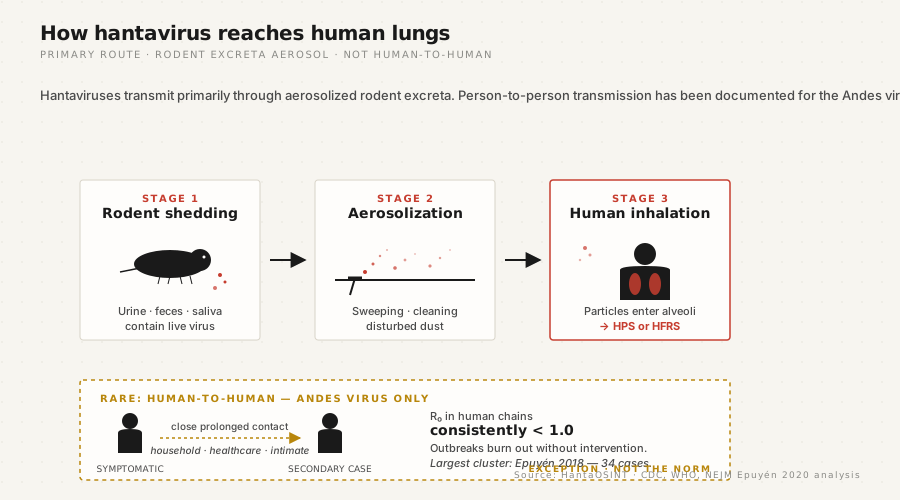
The single exception is Andes virus, endemic to Argentina and Chile. Documented person-to-person Andes virus transmission has occurred — but only under conditions of close, prolonged contact such as household exposure, intimate partnership, or unprotected healthcare contact.
The R₀ in human-to-human Andes virus chains is consistently estimated below 1.0. Outbreaks burn out without sustained intervention. The largest documented person-to-person cluster in history (Epuyén 2018-19) reached 34 cases and resolved within months.
- Strains capableAndes virus only (1 of 50+ species)
- Required conditionsClose, prolonged contact with symptomatic patient
- R₀ in human chainsConsistently <1.0
- Pre-symptomatic spreadNot documented
- Asymptomatic spreadNot documented
- Largest documented clusterEpuyén, Argentina (2018-19) — 34 cases
- Generations propagatedUp to 3 in dense household / funerary settings
- Healthcare exposure riskReal without adequate PPE; standard droplet + N95 sufficient
- Casual contact riskNot documented for any hantavirus
The general rule: no, hantavirus does not spread between people
For nearly every hantavirus species — Hantaan, Sin Nombre, Puumala, Seoul, Dobrava-Belgrade, Choclo, and dozens of others — there has never been documented person-to-person transmission. People who become infected got the virus from rodents, not from other people.
This includes hospital settings. Medical staff caring for HPS or HFRS patients without person-to-person hantaviruses (Sin Nombre in the U.S., Hantaan in East Asia, Puumala in Northern Europe) do not become infected. Family members of patients do not become infected. Casual contacts in restaurants, transit, schools, or workplaces do not become infected. The transmission biology simply does not support it.
This stable epidemiological pattern across more than three decades of hantavirus surveillance is one of the strongest signals in medical entomology that we are not dealing with a pandemic-capable pathogen.
The Andes virus exception
One hantavirus species is different: Andes virus (ANDV), endemic to the Argentine and Chilean Patagonia regions. Person-to-person Andes virus transmission was first suspected in 1996 during the El Bolsón outbreak in Argentina and confirmed by molecular studies in subsequent years.
Why Andes virus and not others? The leading hypothesis is that Andes virus has acquired specific molecular features in its surface glycoproteins that allow it to bind to receptors expressed in human respiratory secretions, making short-range respiratory spread possible under prolonged-contact conditions. Phylogenetic studies show Andes virus has diverged genetically from the broader New World hantavirus group — but no clear single mutation explains the transmission difference, and no other hantavirus has independently acquired this trait.
What conditions allow Andes virus transmission
The 2018-19 Epuyén outbreak in Chubut Province, Argentina, remains the most thoroughly documented person-to-person hantavirus event. The 2020 New England Journal of Medicine analysis identified the specific conditions that allow transmission:
Close physical proximity
Documented transmission has consistently occurred between people sharing personal space — within roughly one metre — for extended periods. Sharing the same room briefly is not sufficient.
Prolonged duration
Transmission requires hours of cumulative exposure, typically over multiple encounters or extended single events. Brief encounters at airports, restaurants, or workplaces have not produced transmission.
Symptomatic source
Pre-symptomatic transmission has never been documented for Andes virus. The viral load in respiratory secretions appears to peak during the cardiopulmonary phase, when patients are visibly seriously ill — not before.
Specific exposure settings
Documented secondary transmission has clustered in four settings:
- Households — spouses, parents, children, others sharing living spaces with a confirmed patient
- Intimate partners — including sexual partners and others in regular close physical contact
- Healthcare without adequate PPE — clinicians caring for severely ill Andes patients without N95 respirators and standard droplet precautions
- Funerary wakes — where mourners spend prolonged periods near deceased patients (this contributed substantially to the Epuyén cluster)
The R₀ problem: why Andes outbreaks burn out
Even with documented person-to-person transmission, Andes virus does not produce sustained epidemics. The basic reproduction number (R₀) — the average number of secondary cases generated by one infected person in a fully susceptible population — is consistently estimated below 1.0 for Andes virus in human chains.
An R₀ below 1 means that, on average, each infected person infects fewer than one other person. Mathematically, this means transmission chains die out: epidemics do not become self-sustaining. Each new generation is smaller than the previous one, and outbreaks resolve naturally even without aggressive public health intervention.
The Epuyén outbreak illustrated this clearly. Despite occurring in a community where multiple super-spreading events created favorable conditions for transmission, the cluster reached only 34 cases over four months and three generations. Aggressive contact tracing and isolation by Argentine and Chilean authorities accelerated containment but did not change the fundamental trajectory.
Compare this to COVID-19, which had R₀ of 2.5–3.0 in its original Wuhan strain and exceeded 8 in Omicron. Or measles at R₀ ~15. Or even seasonal influenza at ~1.3. Andes virus is not in the same epidemiological class.
Historical person-to-person clusters
The complete documented record of person-to-person hantavirus transmission is small enough to enumerate:
- 1996 El Bolsón outbreak (Argentina) — first suspected person-to-person hantavirus event. Roughly 20 cases concentrated among health workers and household contacts.
- 1996 Bariloche cluster (Argentina) — additional confirmation of person-to-person Andes virus transmission.
- 2011 Aysén Region cluster (Chile) — household and nosocomial transmission documented in molecular detail; subject of Vial et al. NEJM 2020 analysis.
- 2018-19 Epuyén outbreak (Argentina) — 34 cases / 11 deaths. Largest documented person-to-person hantavirus cluster. Three generations of transmission. Full outbreak file.
- 2026 MV Hondius cluster (multi-country) — under investigation. Index case appears to be from primary rodent exposure pre-cruise; whether secondary spread occurred among shipboard contacts remains a question for ongoing analysis. Outbreak file.
These represent the known person-to-person transmission record across three decades of intensive hantavirus surveillance. No other hantavirus species has produced any.
What this means for risk perception
Three practical conclusions follow from the transmission biology:
For the general public
Hantavirus is not a concern for the general public unless you have direct rodent exposure history. You cannot catch it from a stranger on a bus, a colleague at work, a friend at dinner, or a passenger on the same flight (with no documented exception). The conventional public health advice — wash hands, avoid sick people — is not relevant because hantavirus does not spread that way.
For healthcare workers
Standard contact and droplet precautions, including N95 respirators when caring for confirmed or suspected Andes virus patients, are sufficient. There has been no documented airborne transmission requiring negative-pressure isolation. Multi-country experience with the MV Hondius cluster has not produced any nosocomial cases attributable to PPE failure.
For pandemic preparedness
Hantavirus is not a credible pandemic candidate under current biology. Pandemic preparedness frameworks should not be re-prioritized based on hantavirus events. The pathogens that do warrant pandemic-tier attention — pandemic-capable influenza, novel coronaviruses, paramyxoviruses with respiratory transmission — are biologically different in ways that matter. Read the full pandemic potential analysis.
Frequently asked questions
Can hantavirus spread from person to person?
Almost never. Of more than 50 known hantavirus species, only Andes virus has documented person-to-person transmission, and even that requires close, prolonged contact such as household, intimate, or unprotected healthcare exposure. The R₀ in human chains is consistently below 1, meaning outbreaks burn out without sustained intervention.
Has anyone died from catching hantavirus from another person?
Yes — but only from Andes virus, and only in the documented person-to-person clusters. The 2018-19 Epuyén outbreak in Argentina produced 34 cases and 11 deaths over three generations of household and funerary transmission. Outside of these specific Andes virus events, no person-to-person transmission has been documented for any hantavirus species.
Can hantavirus spread through coughing or sneezing?
For Andes virus, yes — but only under close-contact conditions and only when the source patient is symptomatic. The respiratory droplets and short-range aerosols from a coughing or breathing patient appear to be the most likely mechanism. For other hantavirus species, no respiratory person-to-person spread has been documented.
Can hantavirus spread sexually or through blood?
Andes virus has been detected in genital secretions and saliva of acutely infected patients, and intimate-partner transmission has been documented. Whether this represents sexual transmission specifically or close-contact respiratory transmission is not clearly distinguished. Blood transfusion transmission has not been documented but blood from acutely infected patients should be assumed potentially infectious.
Should I avoid people who have recovered from hantavirus?
No. Convalescent hantavirus patients are not infectious, including for Andes virus. Once the active infection has resolved (typically within weeks of symptom onset), there is no documented onward transmission. Recovered patients return to normal social and occupational activity without restriction.
Does hantavirus mutate to become more transmissible?
Hantaviruses mutate slowly compared to influenza or coronaviruses. Genomic surveillance over three decades has not identified any hantavirus variant with COVID-style transmission characteristics. The Andes virus circulating today is essentially the same Andes virus identified in 1995. Whether this could change is a theoretical possibility, but the empirical track record argues strongly against rapid mutation toward pandemic transmission.
If hantavirus can spread person-to-person sometimes, why isn't it a pandemic risk?
Because the conditions required for transmission are restrictive enough that R₀ stays below 1. Pandemics require R₀ above 1 in casual-contact settings. Andes virus needs close, prolonged contact in specific intimate or healthcare settings — conditions that do not propagate through general populations. Even the largest historical cluster (Epuyén) burned out at 34 cases in a small community and could not sustain transmission. The math of pandemic spread requires more than person-to-person possibility — it requires efficient transmission, and Andes virus does not have it.
- Vial, P. A., et al. (2020). Person-to-person household and nosocomial transmission of Andes hantavirus, Southern Chile, 2011. New England Journal of Medicine, 383(7).
- Martínez-Valdebenito, C., et al. (2014). Person-to-person household and nosocomial transmission of Andes hantavirus, Southern Chile, 2011. Emerging Infectious Diseases, 20(10), 1629–1636.
- Wells, R. M., et al. (1997). An unusual hantavirus outbreak in southern Argentina: person-to-person transmission? Emerging Infectious Diseases, 3(2).
- Padula, P. J., et al. (1998). Hantavirus pulmonary syndrome outbreak in Argentina: molecular evidence for person-to-person transmission of Andes virus. Virology, 241(2), 323–330.
- Centers for Disease Control and Prevention. Hantavirus transmission.
- World Health Organization. (2026). Disease Outbreak News — Andes virus, multi-country.
- Argentina Ministerio de Salud. Epuyén outbreak documentation.