What is the fatality rate of hantavirus?
Hantavirus case fatality rates range from under 1% (Puumala) to nearly 40% (Andes, Sin Nombre) depending on strain. The genus contains some of the most lethal endemic zoonotic pathogens — and some of the mildest.
Hantavirus case fatality rates vary enormously by strain, from under 1% for Puumala virus (Northern Europe) to roughly 35–40% for Andes and Sin Nombre viruses (the Americas). The genus contains some of the most lethal endemic zoonotic pathogens known to medicine — and some of the mildest.
Hantavirus pulmonary syndrome (HPS), caused by New World strains, has the highest mortality. Hemorrhagic fever with renal syndrome (HFRS), caused by Old World strains, ranges from severe (Hantaan, Dobrava: 5–15%) to very mild (Puumala: <1%).
High mortality does not translate to pandemic risk. Hantaviruses kill efficiently but transmit poorly — a fundamentally different threat profile from pandemic-capable respiratory viruses.
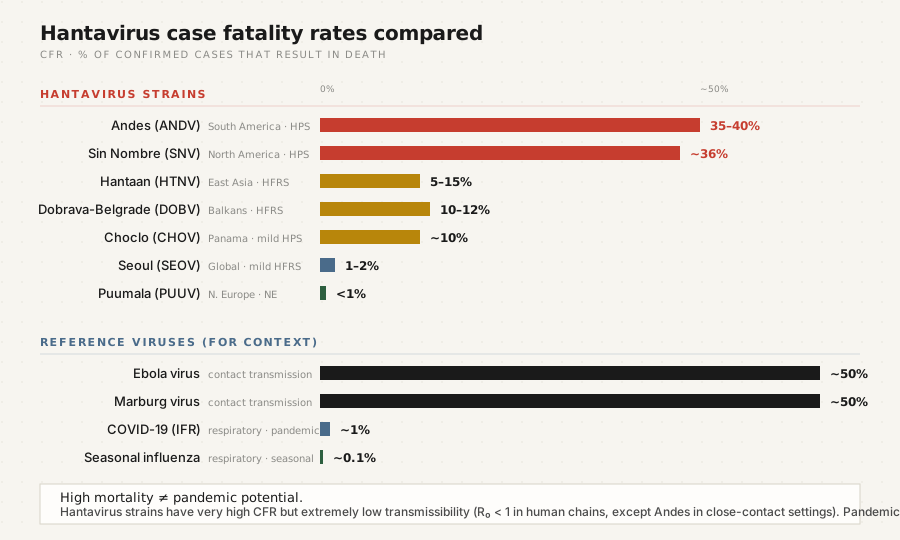
- Andes (ANDV)~35–40% · HPS · S. America
- Sin Nombre (SNV)~36% · HPS · N. America
- Hantaan (HTNV)~5–15% · HFRS · East Asia
- Dobrava-Belgrade (DOBV)~10–12% · HFRS · Balkans
- Choclo (CHOV)~10% · mild HPS · Panama
- Seoul (SEOV)~1–2% · mild HFRS · global
- Puumala (PUUV)<1% · NE · N. Europe
- Method noteCFR = confirmed deaths ÷ confirmed cases. Mild infections often go undetected, making CFR an upper-bound estimate.
Hantavirus fatality rates by strain
The case fatality rate (CFR) of hantavirus disease depends almost entirely on which strain caused the infection. The variation is enormous: a Puumala virus infection in Finland has approximately the same mortality as influenza, while an Andes virus infection in Patagonia has roughly the same mortality as untreated rabies in some series.
The pattern is geographic: New World hantaviruses (Americas) are uniformly more lethal than Old World hantaviruses (Eurasia). Within the Old World, severity scales from north (mild Puumala) to south and east (severe Hantaan, Dobrava). The reasons for this pattern are not fully understood but appear to involve a combination of viral genetic factors and host immune response patterns.
Hantavirus pulmonary syndrome (HPS) — the high-CFR group
Andes virus — the highest published CFR
Andes virus, endemic to Argentina and Chile, has the highest reported case fatality among hantaviruses, at roughly 35–40% in published series. The mechanism is rapid cardiogenic shock combined with pulmonary capillary leak during the cardiopulmonary phase of HPS. Patients can deteriorate from apparent flu-like illness to respiratory failure within 24–48 hours.
Mortality is concentrated in the first 48 hours of the cardiopulmonary phase. Patients who survive to begin diuresis 3–5 days into the cardiopulmonary phase generally recover. Modern intensive care, particularly extracorporeal membrane oxygenation (ECMO) when available, can reduce mortality to roughly 25–30% but does not bring it close to that of more familiar respiratory infections.
Sin Nombre virus — comparable to Andes
Sin Nombre virus, endemic to North America, has CFR of approximately 36% in U.S. national surveillance data. The clinical syndrome is similar to Andes virus HPS, with the same biphasic course and the same mortality concentration in early cardiopulmonary phase. The 1993 Four Corners outbreak that led to Sin Nombre virus identification reported 13 deaths among 24 cases, an early CFR estimate of 54% that has come down with improved surveillance and supportive care.
Choclo virus — milder HPS
Choclo virus, endemic to Panama, causes a milder form of HPS with CFR of approximately 10%. The reasons for this lower lethality remain under investigation but appear to involve less severe pulmonary capillary leak.
Hemorrhagic fever with renal syndrome (HFRS) — the wider range
Hantaan virus — moderate to severe
Hantaan virus, the prototype hantavirus, causes HFRS with CFR of 5–15% in published series from China and South Korea. Mortality has declined significantly since the introduction of vaccination programs in China and improved supportive care. Acute kidney injury and hemorrhagic features dominate the clinical picture; renal replacement therapy is sometimes required.
Dobrava-Belgrade virus — severe European HFRS
Dobrava-Belgrade virus causes the most severe HFRS in Europe, with CFR of 10–12%. Endemic primarily across the Balkans (Slovenia, Bosnia, Serbia, Albania, Greece), it occasionally produces severe outbreak-scale events tied to rodent population cycles.
Seoul virus — mild HFRS
Seoul virus, the only globally distributed hantavirus, causes a relatively mild HFRS with CFR of 1–2%. Most infections are mild enough to go undiagnosed; the actual case fatality is likely lower than published estimates because of detection bias.
Puumala virus — the mildest hantavirus
Puumala virus, endemic across Northern Europe, causes nephropathia epidemica — a mild form of HFRS with CFR consistently below 1%. Most patients recover with supportive care; some experience prolonged renal sequelae but few die. Despite its high case count (1,000–4,000 confirmed cases per year in Finland alone), Puumala accounts for very few deaths.
Why high CFR doesn't equal high pandemic risk
A common misconception is that high mortality means high pandemic risk. The opposite is often true. Pandemics are caused by transmissibility, not lethality:
- Ebola has CFR of 50% but has never caused a global pandemic because transmission requires direct contact with bodily fluids of symptomatic patients.
- Rabies has CFR approaching 100% (untreated) but is essentially never transmitted person-to-person in normal life.
- HIV, untreated, has CFR effectively 100% over time but only spread to pandemic scale because of decades of pre-symptomatic infectiousness.
- COVID-19 had CFR of roughly 1% but caused a global pandemic because of efficient respiratory aerosol transmission with pre-symptomatic spread.
- Seasonal influenza has CFR around 0.1% but kills hundreds of thousands annually because of high transmission and case counts.
Hantavirus fits the Ebola/rabies pattern: high lethality, low transmissibility. The genus is responsible for tragic individual cases but not for pandemic-scale events, and the biology has not changed in three decades of intensive surveillance. Read the pandemic potential analysis.
How CFR is calculated and its limitations
Case fatality rate (CFR) is conventionally defined as:
CFR = (confirmed deaths from disease) ÷ (confirmed cases of disease)
For hantavirus, this calculation has three important caveats:
Detection bias inflates CFR estimates
Mild hantavirus infections frequently go undiagnosed. People who develop only flu-like symptoms and recover are rarely tested for hantavirus, especially outside endemic regions. This means published CFRs are based on the most severe cases that come to medical attention — making the CFR an upper bound on the true infection fatality rate (IFR).
Serological surveys in Argentine endemic regions suggest 5–15% of rural populations have antibody evidence of past Andes virus exposure, far more than the recorded case count would suggest. If these mild or asymptomatic infections were captured in the denominator, the IFR would be substantially lower than the reported 35–40% CFR.
Geographic variation
The same strain can have different CFR in different settings. Sin Nombre CFR has been reported between 30% and 54% in different U.S. cohorts depending on supportive care quality and selection of cases. Hantaan CFR varies between 1% and 15% across China depending on regional healthcare access.
CFR changes with treatment availability
Modern intensive care, particularly mechanical ventilation, vasopressor support, and ECMO when needed, can reduce hantavirus CFR substantially. Cases that occur in resource-limited settings or where exposure history is not promptly recognized fare significantly worse than cases managed in tertiary academic centers. The 50%+ early Sin Nombre CFR has come down to roughly 30–36% with modern supportive care.
Historical perspective on hantavirus mortality
Hantavirus has caused real and substantial mortality in human history. Korean War-era HFRS killed thousands of UN troops in the 1950s. Chinese HFRS killed tens of thousands annually at peak incidence in the 1990s before vaccination programs. The Argentine and Chilean Patagonian endemic continues to produce 30–60 deaths per year combined.
The MV Hondius cluster in 2026, which produced 3 confirmed deaths over 70+ days across 14 countries, is unusual primarily for its geographic dispersal — the fatality count itself is consistent with what you would expect from a small Andes virus cluster of similar size.
For context: hantavirus globally accounts for roughly 200–400 deaths per year across all strains and regions, against a backdrop of millions of deaths from influenza, tuberculosis, malaria, and HIV/AIDS. It is a serious endemic threat in specific geographic and occupational contexts, but it is not a leading cause of viral mortality.
Frequently asked questions
What is the fatality rate of hantavirus?
Case fatality rates vary by strain. Andes virus and Sin Nombre virus (causing HPS in the Americas) have CFR of approximately 35–40%. Hantaan virus (causing HFRS in East Asia) has CFR of 5–15%. Puumala virus (Northern Europe) has CFR under 1%. The genus spans some of the most lethal endemic zoonotic pathogens known to medicine and some of the mildest.
Which hantavirus has the highest mortality rate?
Andes virus has the highest published case fatality rate at approximately 35–40%, closely followed by Sin Nombre virus at around 36%. Both cause hantavirus pulmonary syndrome, where mortality is concentrated in the first 24–48 hours of the cardiopulmonary phase due to acute respiratory distress and cardiogenic shock.
How does hantavirus mortality compare to COVID-19?
Hantavirus has much higher per-case mortality than COVID-19 (which has IFR of roughly 1%) but transmits much less efficiently. Andes virus CFR is roughly 35–40 times higher than COVID-19 IFR. However, COVID-19 has caused millions of global deaths through pandemic spread; hantavirus globally accounts for 200–400 deaths per year. High lethality does not equal high pandemic risk.
Is hantavirus more deadly than Ebola?
The strains causing HPS (Andes, Sin Nombre) have published CFRs of 35–40%, slightly lower than Ebola's typical 40–60% range, but in a similar order of magnitude. Both are high-lethality, low-transmissibility viruses. Ebola requires direct contact with bodily fluids of symptomatic patients; hantavirus requires either rodent exposure or (for Andes virus only) close prolonged contact with a symptomatic patient.
Has anyone survived Andes virus hantavirus pulmonary syndrome?
Yes — most patients survive when they receive prompt supportive care. Modern intensive care reduces Andes virus HPS mortality to roughly 25–30% in published series. Patients who survive to begin diuresis 3–5 days into the cardiopulmonary phase generally recover fully, though some experience fatigue and reduced exercise tolerance for months. Survival depends critically on early recognition, prompt mechanical ventilation, and ECMO when available.
Why is hantavirus so deadly?
Hantavirus pulmonary syndrome causes massive pulmonary capillary leak combined with cardiac dysfunction, producing acute respiratory distress syndrome and cardiogenic shock within hours. There is no specific antiviral treatment; the body's response to the infection is what kills the patient, and modern intensive care can only support failing organs while the immune system clears the virus. The narrow therapeutic window and rapid progression are the main drivers of mortality.
Are hantavirus death rates declining over time?
Yes, modestly. Improved supportive care, including mechanical ventilation, vasopressor support, and ECMO, has reduced HPS case fatality from roughly 50% in the early Sin Nombre era to approximately 30–36% today. Hantaan virus HFRS mortality has declined substantially in China due to vaccination and improved healthcare access. The underlying viruses have not changed; treatment has improved.
- Centers for Disease Control and Prevention. Hantavirus Surveillance — Hantavirus Pulmonary Syndrome.
- Knust, B., & Rollin, P. E. (2013). Twenty-year summary of surveillance for human hantavirus infections, United States. Emerging Infectious Diseases, 19(12), 1934–1937.
- Vial, P. A., et al. (2016). High-dose intravenous methylprednisolone for hantavirus cardiopulmonary syndrome in Chile. Clinical Infectious Diseases.
- Avšič-Županc, T., Saksida, A., & Korva, M. (2019). Hantavirus infections. Clinical Microbiology and Infection, 21S, e6–e16.
- Jiang, H., et al. (2017). Hemorrhagic fever with renal syndrome: pathogenesis and clinical picture. Frontiers in Cellular and Infection Microbiology.
- Pan American Health Organization. Hantavirus epidemiological updates.
- European Centre for Disease Prevention and Control. Annual epidemiological reports — hantavirus.