What is hantavirus? A complete reference guide
Hantavirus is a family of rodent-borne RNA viruses causing two distinct severe diseases — HPS in the Americas and HFRS in Eurasia. This is the comprehensive reference, from virion structure to clinical syndromes to pandemic risk.
Hantavirus is a family of rodent-borne RNA viruses that infect humans through aerosolized rodent excreta and cause two distinct severe disease syndromes: hantavirus pulmonary syndrome (HPS) in the Americas and hemorrhagic fever with renal syndrome (HFRS) in Eurasia.
The genus contains more than 50 known species. The most clinically important strains are Andes, Sin Nombre, Hantaan, Puumala, Seoul, Dobrava-Belgrade, and Choclo. Case fatality rates range from under 1% (Puumala) to nearly 40% (Andes, Sin Nombre).
Hantavirus is not airborne in the COVID sense — there is no efficient human-to-human transmission. Andes virus is the sole exception, and even it transmits only through close, prolonged contact.

- FamilyHantaviridae (order Bunyavirales)
- GenusOrthohantavirus
- GenomeSingle-stranded, negative-sense RNA · three segments (L, M, S)
- Particle size80–120 nanometres, enveloped
- ReservoirRodents (mice, voles, rats); some shrews and bats
- Disease syndromesHPS (Americas) · HFRS (Eurasia) · NE (mild HFRS, N. Europe)
- Case fatality<1% to ~40% depending on strain
- VaccineLicensed only in China and South Korea (for Hantaan/Seoul); none for Americas strains
- Specific antiviralNone. Treatment is supportive: oxygen, ventilation, ECMO, dialysis as needed
- Person-to-personDocumented for Andes virus only; rare and requires close contact
What is a hantavirus, exactly?
A hantavirus is a member of the genus Orthohantavirus, a group of enveloped RNA viruses in the family Hantaviridae. They are zoonotic, meaning they normally circulate in animal hosts and only occasionally cross over into humans. Unlike most respiratory viruses, the natural cycle of a hantavirus does not include humans at all — we are dead-end hosts. The virus does not benefit from infecting us, which is why it does not transmit efficiently between people.
The genus name comes from the Hantan River in South Korea, near where the prototype virus (Hantaan virus) was identified in 1976 from a striped field mouse. That identification ended a decades-long search for the cause of "Korean hemorrhagic fever," which had killed thousands of UN troops during the Korean War.
Virion structure and genome
Hantaviruses are roughly spherical particles 80 to 120 nanometres across — about a thousand times smaller than a red blood cell. The outer layer is a lipid envelope studded with two surface glycoproteins (Gn and Gc) arranged in heterodimers that mediate cell entry. Inside the envelope sits the nucleocapsid, which contains the viral genome.
The genome is unusual: it is segmented into three pieces of single-stranded, negative-sense RNA, each in its own ring within the nucleocapsid. The large (L) segment codes for the RNA-dependent RNA polymerase that copies the viral genome. The medium (M) segment codes for the precursor of the surface glycoproteins. The small (S) segment codes for the nucleoprotein, which packages the RNA. This three-segment architecture is the diagnostic genetic signature of the genus.
The major hantavirus strains
The Hantaviridae family contains more than 50 recognized species. Of these, fewer than ten cause significant human disease, and they are typically grouped into "New World" strains (Americas, causing HPS) and "Old World" strains (Eurasia, causing HFRS).
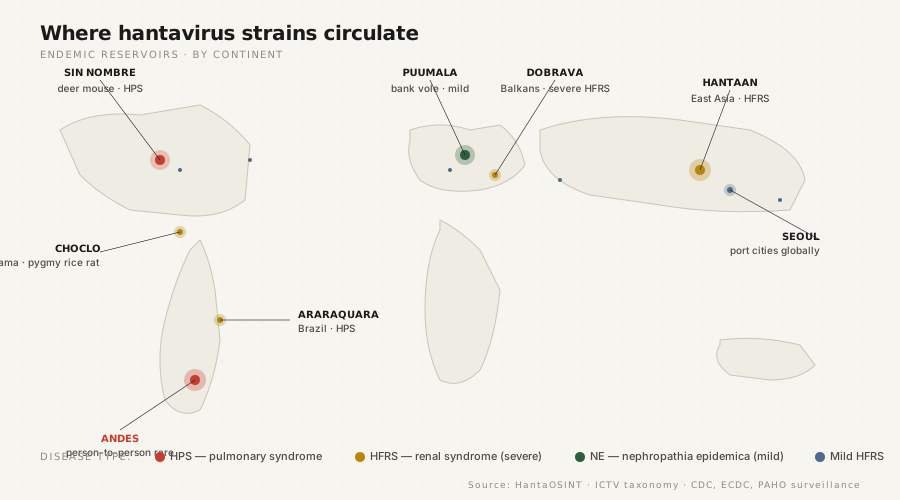
The most clinically important strains are:
- Andes virus (ANDV) — endemic to Argentina and Chile. Causes HPS. The only hantavirus with documented person-to-person transmission. Cause of the 2026 MV Hondius cluster.
- Sin Nombre virus (SNV) — endemic across the U.S. West. Causes HPS. Identified during the 1993 Four Corners outbreak.
- Hantaan virus (HTNV) — endemic in East Asia. Causes severe HFRS. Historically the highest case burden globally.
- Puumala virus (PUUV) — endemic across Northern Europe. Causes nephropathia epidemica, a mild form of HFRS. The most common European strain.
- Seoul virus (SEOV) — globally distributed via Norway and black rats. Causes mild HFRS. The only truly cosmopolitan hantavirus.
- Dobrava-Belgrade virus (DOBV) — endemic in the Balkans. Causes the most severe HFRS in Europe.
- Choclo virus (CHOV) — endemic in Panama. Causes a milder form of HPS than Andes or Sin Nombre.
Rodent reservoirs and viral specificity
Each hantavirus species is tightly bound to one or a small number of rodent reservoir species. This is the defining feature of the genus. Andes virus circulates in the long-tailed pygmy rice rat (Oligoryzomys longicaudatus) and essentially nowhere else. Sin Nombre virus circulates in the deer mouse (Peromyscus maniculatus). Puumala virus circulates in the bank vole. The geographic range of each virus is the geographic range of its reservoir.
Infected rodents typically show no signs of disease. The virus persists in their lungs, kidneys, and reproductive tissue for life, and is shed continuously in urine, feces, and saliva. Human infections occur as accidental spillover events when people enter rodent habitats or rodents enter human habitats.
Two clinical syndromes: HPS and HFRS
Hantaviruses cause two distinct disease syndromes depending on the strain and geography. They share an early prodromal phase but diverge in their dominant organ involvement.
Hantavirus pulmonary syndrome (HPS)
Caused by New World hantaviruses — Andes, Sin Nombre, Choclo, Araraquara, and others. The dominant feature is pulmonary capillary leak leading to rapid-onset acute respiratory distress syndrome. The clinical course is biphasic: 3-7 days of flu-like symptoms followed by abrupt cardiopulmonary deterioration. Case fatality is typically 30-40%.
Hemorrhagic fever with renal syndrome (HFRS)
Caused by Old World hantaviruses — Hantaan, Seoul, Puumala, Dobrava-Belgrade. The dominant feature is renal capillary leak with acute kidney injury, often accompanied by hemorrhagic features such as petechiae and gastrointestinal bleeding. CFR ranges from under 1% (Puumala) to 5-15% (Hantaan, Dobrava). The mildest form, nephropathia epidemica caused by Puumala virus, often resolves with little intervention.
For more detail, see our clinical course briefing.
A brief history of hantavirus discovery
Hantaviruses were not formally identified until the 1970s, but the diseases they cause have been recognized for centuries. Outbreaks resembling HFRS were described among Russian and Japanese troops in Manchuria during the 1930s. Korean War-era cases led to systematic investigation that culminated in the 1976 isolation of Hantaan virus.
HPS was unrecognized until 1993, when a cluster of unexplained respiratory deaths among Native Americans in the Four Corners region of the U.S. was traced to a previously unknown hantavirus carried by deer mice. The strain was named "Sin Nombre" (Spanish for "no name") because investigators initially could not agree on a toponym and the discovery had to be published quickly.
Andes virus, with its distinctive ability to transmit person-to-person, was identified in 1995 during outbreak investigations in Patagonia. The 2018-19 Epuyén outbreak in Argentina remains the largest documented person-to-person hantavirus cluster.
Why hantavirus matters in 2026
Three converging factors have raised hantavirus's profile in 2026. First, the MV Hondius cluster brought a multi-country Andes virus event into international news for the first time in over a decade. Second, Argentine endemic cases nearly doubled in 2025-26, driven by climate-related rodent population shifts. Third, growing pandemic preparedness investment has put zoonotic surveillance back on the public agenda.
Hantavirus is not a pandemic threat in any conventional sense — its biology does not support efficient human-to-human spread. But it is a useful exemplar for understanding how zoonotic spillover works, how surveillance can detect novel events early, and how public health systems coordinate across borders.
Frequently asked questions
What is hantavirus in simple terms?
Hantavirus is a group of viruses spread to humans by rodents. People get infected by breathing in tiny particles of dried rodent urine, droppings, or saliva that have become airborne when disturbed. There is no vaccine for the strains found in the Americas, and no specific treatment beyond supportive care. It is dangerous when it occurs but not contagious in the way COVID or flu are — it doesn't spread person-to-person except in rare cases involving Andes virus.
How many types of hantavirus are there?
The genus Orthohantavirus contains more than 50 recognized species worldwide. Fewer than ten cause significant human disease. The most clinically important are Andes, Sin Nombre, Hantaan, Puumala, Seoul, Dobrava-Belgrade, and Choclo. New species continue to be identified, mainly through wildlife surveillance.
Is hantavirus a virus or a bacteria?
Hantavirus is a virus. Specifically, it is a single-stranded, negative-sense RNA virus with a segmented genome (three segments: L, M, and S). It belongs to the order Bunyavirales and family Hantaviridae. Antibiotics have no effect on it because they target bacteria, not viruses.
Where does hantavirus come from?
Hantavirus circulates naturally in rodent populations on every inhabited continent except Antarctica. Each viral species is tied to a specific rodent reservoir species. Humans become infected only through accidental contact with infected rodent excreta — typically during cleaning of rodent-infested spaces, agricultural work, or recreational activity in endemic regions.
Is hantavirus a new disease?
The diseases caused by hantavirus have been recognized for over a century, but the viruses themselves were not formally identified until the 1970s. Hantavirus pulmonary syndrome was unrecognized until 1993, when the Four Corners outbreak in the U.S. led to identification of Sin Nombre virus. New hantavirus species continue to be discovered, but none have shown human-to-human transmission characteristics that would suggest pandemic potential.
Is hantavirus the same as bird flu or COVID-19?
No. Hantavirus is a different family of viruses with very different transmission biology. Bird flu (avian influenza) is a respiratory virus that can spread between humans under some conditions. COVID-19 (SARS-CoV-2) spreads efficiently between humans through respiratory aerosols. Hantavirus does not spread efficiently between humans at all — its primary route is from rodent excreta directly to a human, not human-to-human.
- International Committee on Taxonomy of Viruses (ICTV). Hantaviridae taxonomy 2026 release.
- Centers for Disease Control and Prevention. Hantavirus Information for Health Professionals.
- World Health Organization. Disease Outbreak News — Hantavirus.
- Jonsson, C. B., Figueiredo, L. T. M., & Vapalahti, O. (2010). A global perspective on hantavirus ecology, epidemiology, and disease. Clinical Microbiology Reviews, 23(2), 412–441.
- Vial, P. A., et al. (2020). Person-to-person household and nosocomial transmission of Andes hantavirus, Southern Chile, 2011. New England Journal of Medicine.
- European Centre for Disease Prevention and Control. Hantavirus disease in Europe.