How does hantavirus spread? Transmission pathways explained
Hantavirus reaches humans almost exclusively through aerosolized rodent excreta — a transmission route fundamentally different from the airborne human-to-human spread of pandemic respiratory viruses. Here is the complete picture.
Hantavirus spreads to humans almost exclusively through aerosolized rodent excreta — dried urine, feces, or saliva from infected rodents that becomes airborne when disturbed. The most common exposure scenarios are cleaning enclosed spaces with rodent activity, agricultural work, and recreational activity in cabins or sheds.
Person-to-person transmission has been documented for one strain — Andes virus — and only under conditions of close, prolonged contact such as household, intimate, or unprotected healthcare exposure. No other hantavirus has ever been shown to transmit between humans.
The virus is not airborne in the COVID sense: there is no efficient ambient-air spread between strangers. Risk is bounded by activity, not geography.
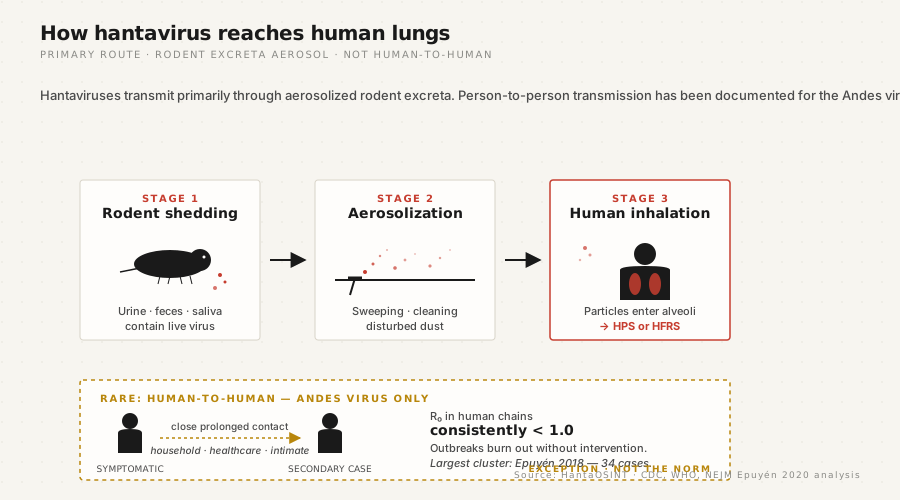
- Primary routeAerosolized rodent excreta (urine, feces, saliva)
- Secondary routesDirect rodent contact · contaminated food · rare rodent bite
- Person-to-personAndes virus only · close, prolonged contact required
- Incubation1–6 weeks (median 14–21 days)
- Pre-symptomatic spreadNegligible
- Asymptomatic spreadExtremely rare
- R₀ in human chains<1 (outbreaks burn out)
- Highest-risk activitiesCleaning rodent-infested spaces · agriculture · cabin/shed entry after seasonal closure
- Key protective measureN95 respirator + wet cleaning when entering rodent-contaminated areas
The primary transmission route: aerosolized rodent excreta
The dominant way hantavirus reaches human lungs is mechanical and physical, not biological:
- An infected rodent sheds virus continuously in its urine, feces, and saliva
- This material dries on surfaces — barn floors, cabin corners, attic insulation, sheds, dusty agricultural equipment
- Something disturbs the dried material — sweeping, vacuuming, walking through dust, opening sealed boxes, agricultural work
- The disturbance creates fine airborne particles containing intact virus
- A nearby human inhales those particles, which travel deep into the alveoli where the virus initiates infection
The critical detail is that this pathway requires both an infected rodent and a disturbance. Hantavirus does not float in ambient outdoor air. It does not contaminate food chains. It is not transmitted by mosquitoes, ticks, or other arthropods. Without rodent presence and without disturbance of dried material, there is essentially no risk.
Secondary transmission routes
Beyond the primary aerosol route, three secondary routes have been documented but account for only a small fraction of human cases:
Direct contact with rodent material
Touching contaminated material and then touching the eyes, nose, or mouth can transmit the virus, though much less efficiently than inhalation. This is why the CDC recommends gloves alongside respirators when cleaning rodent-contaminated areas.
Rodent bites
Bites from infected rodents have been documented as a transmission route, particularly for Seoul virus in pet rat owners and rat fanciers. This is rare in normal life but accounts for a small fraction of Seoul virus cases globally.
Contaminated food or water
Food directly contaminated by rodent excreta has been implicated in some HFRS clusters in East Asia, though aerosolization during food handling may be the actual route rather than ingestion. The role of contaminated water has been investigated but not conclusively demonstrated.
Person-to-person transmission: the Andes virus exception
Of more than 50 known hantavirus species, exactly one has documented person-to-person transmission: Andes virus, endemic to Argentina and Chile. Even within Andes virus, transmission is rare and constrained.
The 2018-19 Epuyén outbreak in Argentinian Patagonia is the most thoroughly documented person-to-person hantavirus event. It originated at a birthday gathering on 25 November 2018, propagated through three identifiable generations of contacts, and produced 34 confirmed cases and 11 deaths before being contained. The 2020 New England Journal of Medicine analysis of that outbreak remains the reference for understanding what conditions allow person-to-person transmission:
- Close contact — typically within one metre, for hours at a time
- Prolonged duration — minutes of casual exposure are not enough
- Symptomatic source — pre-symptomatic transmission has not been documented
- Specific settings — household members, intimate partners, healthcare workers without adequate PPE, close mourners at funerary wakes
The basic reproduction number (R₀) in human-to-human Andes virus chains has been estimated well below 1 in nearly all settings — meaning each case generates fewer than one secondary case on average. Outbreaks burn out without intervention. For more detail see our dedicated briefing on person-to-person transmission.
Incubation period and infectiousness window
The incubation period — the time between exposure and symptom onset — is typically 1 to 6 weeks for hantavirus, with a median of 14 to 21 days. This is unusually long for a respiratory virus and has important implications for contact tracing.
For comparison, COVID-19's incubation is 2-14 days (median ~5), influenza is 1-4 days, and measles is 7-14 days. Hantavirus's longer incubation means that by the time someone develops symptoms and is being investigated, the original exposure was weeks ago — which complicates source tracing but also means that people developing symptoms today were not infected today.
Infectiousness, in the rare cases of person-to-person Andes virus transmission, appears to begin at or shortly before symptom onset and persists through the cardiopulmonary phase. Pre-symptomatic transmission has not been documented for any hantavirus species.
Highest-risk activities and settings
Most human hantavirus exposure occurs during specific identifiable activities:
- Spring cleaning of rural cabins sealed during winter months — this is the classic Sin Nombre virus exposure scenario in the U.S. West
- Agricultural work, particularly grain storage, equipment maintenance in barns, and harvest activities involving stored crops
- Construction, demolition, or renovation of structures with rodent activity, especially in attics or crawl spaces
- Camping or recreation in cabins, sheds, or outbuildings, especially those that have been closed for extended periods
- Outdoor work in endemic regions — forestry, landscaping, fence-line work near rodent habitat
- Pet rat handling — for Seoul virus specifically, the rat-fancier community has been the source of multiple Western cluster outbreaks
- Healthcare exposure to confirmed Andes virus patients without N95-equivalent PPE — for that strain only
What is not a hantavirus risk
Equally important: many activities and exposures are not meaningful hantavirus risks:
- Casual contact in offices, schools, restaurants, public transport — no documented transmission in these settings
- Air travel sharing a flight with an infected person — except possibly in the case of an actively symptomatic Andes virus patient in close contact, but no flight transmission has been documented to date
- Eating food cooked by an infected person — the virus is destroyed by normal cooking and there is no enteric transmission route
- Casual contact with someone who has recovered — convalescents are not infectious
- Bites from mosquitoes, ticks, or fleas — hantavirus is not arthropod-borne
- Drinking municipal tap water — water-borne transmission has not been demonstrated
- Indoor air in rodent-free buildings — without an infected rodent, there is no source
How to actually protect yourself
Prevention is straightforward and effective, because the transmission route is so well-defined:
- Seal entry points in your home and outbuildings to keep rodents out — caulk gaps larger than 6 mm, seal around pipes and utilities
- Ventilate before entering any cabin, shed, or outbuilding that has been closed for weeks. Open doors and windows for at least 30 minutes before going inside
- Wet-clean rather than sweep or vacuum any suspected rodent contamination. Spray surfaces with a 1:10 bleach solution or commercial disinfectant, let sit for 5 minutes, then wipe with disposable cloths
- Wear an N95 respirator (or better) and disposable gloves whenever you may disturb rodent excreta. Standard surgical masks do not filter particles small enough to matter
- Wash hands and exposed skin with soap and water afterward; launder clothing in hot water
- If you live in an endemic region, seek medical attention promptly if you develop fever and severe muscle aches within 6 weeks of a possible exposure event. Tell your provider about the rodent or travel history explicitly — hantavirus is rare enough that doctors do not look for it unless prompted
Frequently asked questions
How does hantavirus spread?
Hantavirus spreads to humans primarily by inhalation of aerosolized rodent excreta. Infected rodents shed the virus in urine, feces, and saliva, which dry on surfaces. When the dried material is disturbed — by sweeping, vacuuming, agricultural work, or simply walking through dusty enclosed spaces — fine particles become airborne and can be inhaled. The virus then initiates infection in the lungs.
Can hantavirus spread through the air?
Hantavirus can be aerosolized from rodent excreta but does not spread between humans through ambient air the way COVID-19 or measles do. The aerosol is local and transient — it requires both an infected rodent source and a disturbance to release particles. Without those conditions, there is no airborne risk. Read the full briefing on airborne transmission.
Can you catch hantavirus from another person?
Almost never. Of more than 50 known hantavirus species, only Andes virus (endemic to Argentina and Chile) has documented person-to-person transmission, and even that requires close, prolonged contact such as household, intimate, or unprotected healthcare exposure. The R₀ in human chains is well below 1, meaning outbreaks burn out without intervention. Detailed analysis here.
How long does hantavirus survive on surfaces?
Hantavirus is relatively environmentally stable. Studies suggest the virus can remain infectious on surfaces and in dried excreta for several days to a few weeks under typical indoor conditions, particularly in cooler temperatures and out of direct sunlight. UV light, heat, and standard household disinfectants (bleach 1:10) inactivate it readily.
Can pets transmit hantavirus to humans?
Cats and dogs are not natural reservoirs of hantavirus and do not transmit it to humans. The exception is pet rats — Seoul virus has caused multiple outbreaks among pet rat owners, breeders, and the rat-fancier community in the U.S., U.K., Canada, and Netherlands. If you keep pet rats, hand hygiene and respirator use during cage cleaning are reasonable precautions.
Can you get hantavirus from camping?
You can, but the risk depends on where and how you camp. Camping in tents in open ground in endemic regions carries low risk because there is no enclosed rodent habitat to disturb. Staying in cabins, lodges, or outbuildings that have been closed for extended periods raises the risk substantially — the 2012 Yosemite tent cabin outbreak is the textbook example. Ventilate enclosed structures before sleeping in them, and avoid sweeping dusty surfaces.
Is hantavirus contagious before symptoms appear?
No documented pre-symptomatic transmission has occurred for any hantavirus species, including Andes virus. People become potentially infectious to close contacts only when they become symptomatic — and even then, only Andes virus has shown person-to-person spread. The long incubation period (1-6 weeks) and absence of pre-symptomatic transmission make hantavirus very different from COVID-19 in epidemiological terms.
- Centers for Disease Control and Prevention. Hantavirus transmission.
- Vial, P. A., et al. (2020). Person-to-person household and nosocomial transmission of Andes hantavirus, Southern Chile, 2011. New England Journal of Medicine.
- Martínez-Valdebenito, C., et al. (2014). Person-to-person household and nosocomial transmission of Andes hantavirus. Emerging Infectious Diseases, 20(10), 1629–1636.
- European Centre for Disease Prevention and Control. Hantavirus disease — risk groups and exposure scenarios.
- Argentina Ministerio de Salud. Hantavirus surveillance bulletins — Epuyén outbreak documentation.
- Pan American Health Organization. Hantavirus pulmonary syndrome epidemiological updates.